When shopping for a new smartphone, laptop, or portable charger, shoppers frequently encounter two specifications that sound almost identical: battery capacity and battery life. While device makers often tout massive storage numbers to imply endless endurance, the two metrics measure fundamentally different aspects of portable power.
Confusing these terms can lead to disappointing purchases, such as buying a power bank that fails to deliver its advertised recharges or an Android phone with a colossal battery that dies faster than an iPhone with a smaller cell. Understanding how energy storage translates into actual operating time—and how long-term battery health fits into the equation—is essential for getting the most out of modern consumer electronics.
Defining the Terms: What Battery Capacity Actually Measures
Battery capacity represents the total volume of electrical charge a battery can store when fully replenished. Think of capacity as the physical size of a vehicle's fuel tank: it dictates how much potential energy the system holds, but it says nothing about how aggressively the engine burns through that fuel.
Engineers quantify capacity using specific electrical units depending on the size and architecture of the device:
- Milliampere-hours (mAh): The universal standard for handheld electronics like smartphones, smartwatches, and pocket power banks. A 5,000mAh rating indicates the battery can deliver 5,000 milliamps of current for one hour, or 1,000 milliamps for five hours, at its nominal internal voltage.
- Watt-hours (Wh): The preferred standard for laptops, tablets, portable power stations, and electric vehicles. Calculated by multiplying ampere-hours by operational voltage (Wh = Ah × V), watt-hours represent an absolute measurement of energy that allows direct comparisons across devices with wildly differing voltage setups.
Because capacity is purely a physical and chemical ceiling governed by the lithium-ion cells inside the chassis, it remains static until age and thermal wear gradually degrade the chemistry.
The Runtime Reality: Why Battery Life Isn't Just a Number
 Photo: Engadget - Technology News & Expert Reviews (source)
While capacity is an absolute technical rating, battery life is a dynamic measure of time. Commonly referred to as "runtime" or "endurance," it measures how many hours or minutes a gadget operates on a single charge before the operating system shuts down.
Battery life is dictated by a basic mathematical ratio: the total energy stored (capacity) divided by the rate at which the device burns that energy (power consumption). Even if two competing phones feature identical 5,000mAh cells, their battery life can differ by several hours depending on their processors, cellular modems, screen brightness, and thermal management.
The phrase is also sometimes used in industry contexts to describe a battery's total lifespan—how many months or years the component remains usable before it can no longer hold an acceptable charge. In daily consumer usage, however, battery life almost universally refers to the duration between trips to the wall outlet.
The Power Bank Myth: Why Capacity Ratings Don't Add Up in Real Life
One of the most common consumer frustrations stems from external battery packs. A user buying a 10,000mAh power bank often assumes it can fully recharge a 4,288mAh smartphone slightly more than two full times. In practice, that same pack often delivers only about 1.5 charges.
This discrepancy happens because labeled capacity does not equal usable transferred energy. Internal lithium-ion cells operate at a nominal voltage of roughly 3.7 volts, but standard USB charging delivers power at 5 volts, 9 volts, or higher. Boosting the voltage inside the power bank's circuitry and stepping it back down inside the phone incurs electrical resistance and heat losses.
Standard power banks experience between 20% and 35% energy loss during transfer. High-speed fast charging exacerbates this waste by generating substantial excess heat. Wireless Qi or MagSafe charging creates even greater inefficiencies, routinely losing up to 40% to 50% of the transferred energy as ambient heat.
The Efficiency Equation: Hardware, Silicon, and Display Demands
 Photo: Engadget - Technology News & Expert Reviews (source)
The gap between paper capacity and real-world endurance comes down to system optimization. Massive batteries are often used by manufacturers to compensate for inefficient hardware or unoptimized software.
A prime example exists in the comparison between tablets and smartphones. An Apple iPad carries a battery roughly three to four times the capacity of a standard iPhone. Yet, both devices typically deliver similar runtimes of 10 to 12 hours of active web browsing. The iPad's expansive display requires significantly more backlighting and power to illuminate its millions of pixels, wiping out the endurance advantage of its larger cell.
Silicon architecture plays an equally massive role. Advanced system-on-chips fabricated on cutting-edge 3-nanometer nodes consume drastically fewer milliwatts per computing cycle than older or budget chips. Similarly, LTPO OLED displays that throttle refresh rates down to 1Hz when reading static text preserve immense amounts of energy compared to fixed 120Hz panels. When high background app activity, 5G searching in poor coverage zones, or heavy 3D rendering kick in, energy draw spikes, draining high-capacity batteries in record time.
Capacity vs. Life vs. Health: A Side-by-Side Breakdown
To keep device metrics clear, compare how capacity, battery life, and overall battery health interact:
| Metric | What It Measures | Standard Units | What Influences It | How to Track It |
|---|---|---|---|---|
| Battery Capacity | Maximum volume of electrical charge the battery can physically hold | mAh, Wh, Ah | Cell chemistry, physical pack volume, manufacturing design | Printed on spec sheets and battery casing |
| Battery Life (Runtime) | Duration of continuous use between full charge and shutdown | Hours, Minutes | Screen brightness, processor efficiency, network conditions, task load | Built-in Screen-On Time (SOT) and OS usage stats |
| Battery Health | Remaining maximum capacity relative to when the device was brand-new | Percentage (e.g., 85%) | Charge cycles completed, operating temperatures, charging speeds | iOS Battery Health, Android Battery Information, macOS System Profiler |
The Third Metric: Battery Health and Charge Cycles
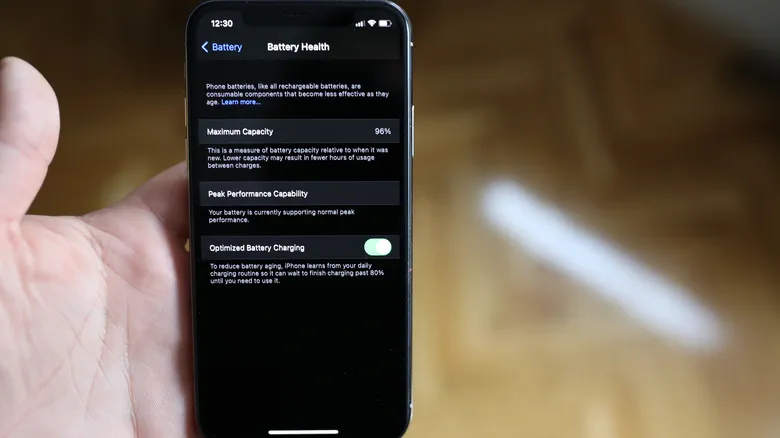 Photo: Engadget - Technology News & Expert Reviews (source)
You cannot discuss capacity and endurance without examining battery health. As rechargeable lithium-ion cells age chemically, their internal resistance rises, reducing the total amount of charge they can hold.
Battery health is expressed as a percentage of original factory capacity. If a laptop shipped with an 80Wh battery and its health drops to 80%, it now effectively functions as a 64Wh battery. Consequently, even if user habits stay identical, real-world battery life will decline by 20%.
This degradation is directly tied to charge cycles. One complete cycle occurs whenever 100% of the battery's capacity has been discharged, whether in a single session or across multiple days. Modern mobile devices generally promise to retain 80% capacity across 800 to 1,000 complete cycles. For an average consumer charging once per day, that translates to approximately two-and-a-half to three years before noticeable degradation occurs.
How to Maximize Both Daily Runtime and Long-Term Lifespan
Optimizing portable electronics requires balancing immediate daily uptime against long-term chemical preservation. Modern operating systems now offer native tools to manage both sides of the coin:
- Enable Charge Limits: Both iOS and Android now offer settings to cap charging at 80%. While this slightly lowers single-day battery life, it prevents high internal cell voltage, substantially prolonging the battery's multi-year capacity.
- Mitigate Heat During Charging: High heat is the primary accelerator of chemical decay. Avoid heavy 3D gaming or direct sun exposure while fast charging, and use wired connections rather than inefficient wireless pads when rapid replenishment is needed.
- Optimize Energy Vampires: To improve daily battery life without altering capacity, enable adaptive refresh rates, lower display brightness, restrict background location services, and rely on Wi-Fi instead of marginal cellular connections.
FAQ
Can two phones have the same battery capacity but completely different battery life? Yes. A device with a more efficient chipset, an LTPO display, and an optimized operating system will easily outlast a phone with identical capacity that runs power-hungry processors and bloated software.
Does fast charging reduce my battery's capacity? Fast charging itself does not automatically destroy capacity, but the intense heat generated by high-wattage charging accelerates chemical degradation over time. Devices with robust thermal dissipation handle rapid charging with far less long-term penalty.
Why does a 10,000mAh portable charger not charge a 5,000mAh phone twice? Voltage conversion from 3.7V up to 5V or 9V, resistance inside the charging cable, and heat generated during the power transfer cause a 20% to 35% energy loss. A 10,000mAh bank typically delivers around 6,500mAh to 7,500mAh of actual usable power.
When should I replace my device's battery? Industry standards recommend replacing the battery once maximum capacity drops below 80%. At that stage, you will notice significantly shorter daily runtime, and the device may throttle peak performance to prevent unexpected shutdowns.